

☰
AMAZON PPC · PRACTICAL GUIDE
Amazon ACoS vs ROAS: Set a Target That Fits Your Margins
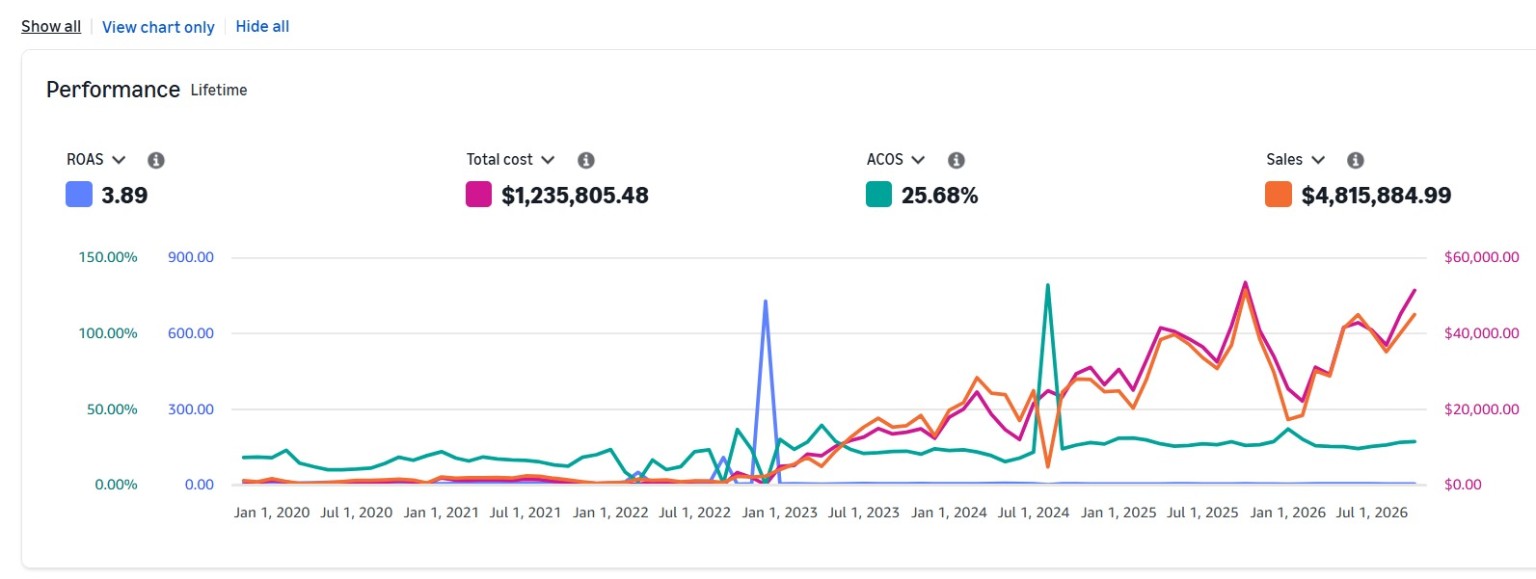
A strong-looking ROAS can still leave little money after product costs and fees. Before increasing an Amazon PPC budget, decide how much each sale can contribute toward advertising. Then use campaign metrics to assess that target rather than copying another seller’s benchmark.
Two views of the same relationship
Amazon defines ACoS as advertising spend divided by ad-attributed revenue, expressed as a percentage. ROAS reverses the calculation: attributed revenue divided by advertising spend. They describe revenue efficiency, not net profit. For the same inputs, ACoS of 25% corresponds to ROAS of 4. There is no single ACoS target that suits every product. Source: Amazon Ads ACoS guide.
A worked example: start with contribution
Illustrative example, not client performance: a product sells for $40. Assume its product cost, marketplace and fulfilment fees, and other variable costs total $28. That leaves $12 before advertising: a 30% contribution margin. At $12 advertising cost per attributed sale, that contribution is exhausted. Under these assumptions, break-even ACoS is 30% and break-even ROAS is approximately 3.33.
If the business also wants $4 contribution per sale after advertising, only $8 remains available for ads. That gives a planning target of 20% ACoS or 5 ROAS. This is our calculation under the stated assumptions, not an Amazon recommended benchmark. Include the actual costs relevant to your operation; overhead, returns and taxes can change the commercial conclusion.
Why a higher ROAS does not settle the question
Amazon’s profitability guidance explains that revenue multiples need margin context. A low-margin product can lose money at a ROAS that would be acceptable for a higher-margin product. Its break-even model divides one by the margin in decimal form. Source: Amazon Ads practical calculations.
Our review checklist before scaling
- Write down the product-level cost assumptions and the contribution you want to retain.
- Use comparable reporting periods and the same attribution scope when comparing campaigns.
- Separate the question “did attributed sales rise?” from “did retained contribution rise?”
- Record price, promotion or stock changes alongside ad adjustments so that the next review has context.
Those steps form an editorial planning framework, not proof that advertising caused every reported sale. A dashboard ratio is a starting point for a commercial decision.
Keep the target specific
Instead of asking whether 20% ACoS is universally good, ask whether the current target fits this product, these costs and this campaign objective. Review that decision when the economics change. Explore our anonymized PPC reports to see why reporting scope matters.